
Given a fahb_problem object calculate summary statistics which can inform
progression decisions. These include both standard progression criteria
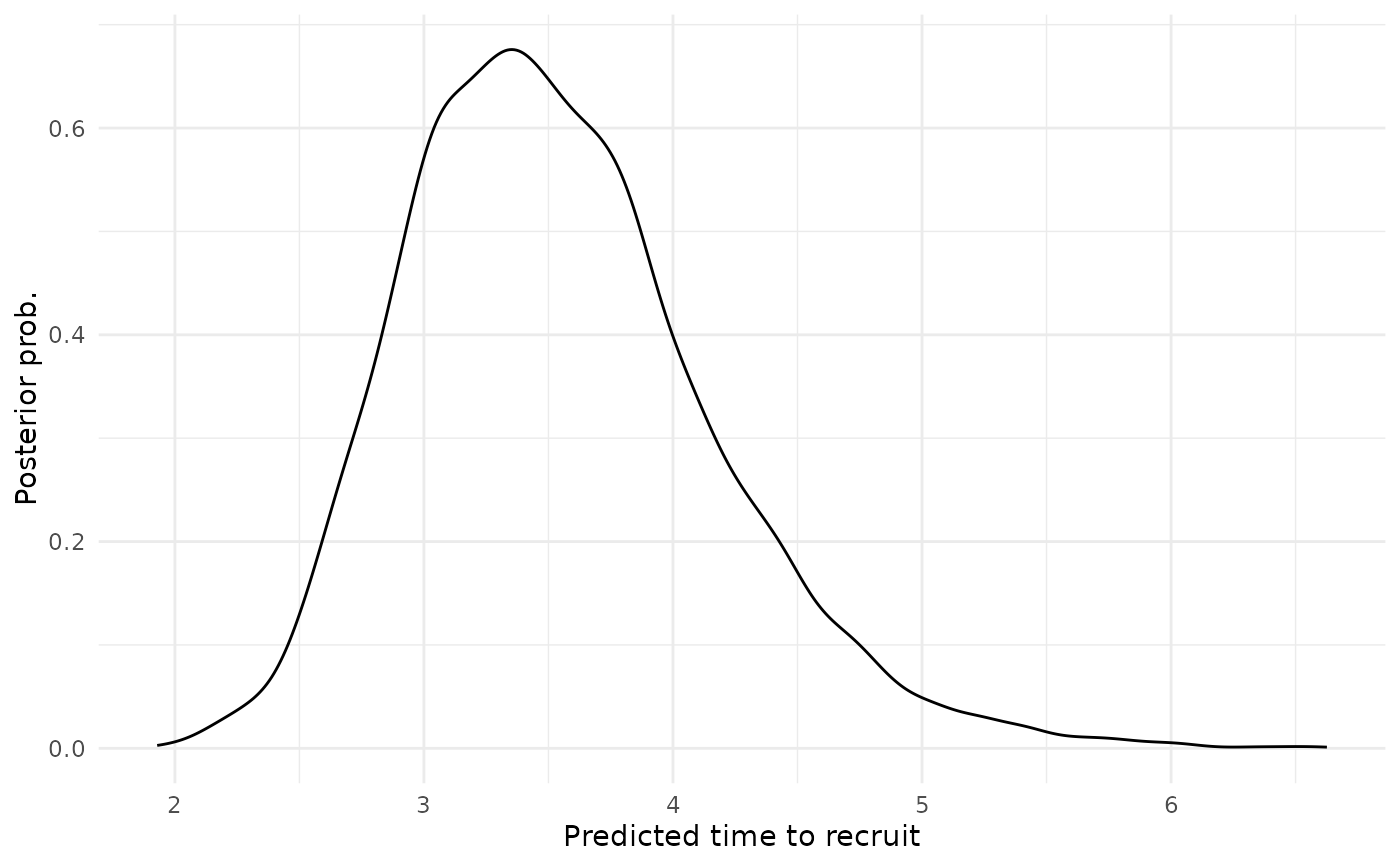
statistics, and the expectation of the posterior predictive distribution of
the time until the trial recruits.
Arguments
- n_pilot
integer vector of numbers recruited at each open site.
- t_pilot
numeric vector of time (in years) each site has been open.
- problem
object of class
fahb_problem.- site_t
In the case of an external pilot, the time taken for all pilot sites to open.
- bayes_model
optional object of class
brmsfitwhich will be used in the Bayesian analysis viabrms::update()to avoid compiling a new model.
Examples
## Example illustrating a full analysis workflow
## (Not run on CRAN due to Bayesian model fitting)
# \donttest{
problem <- fahb_problem()
problem <- forecast(problem)
## Pilot trial data
n_pilot <- c(3, 5, 2)
t_pilot <- c(0.5, 0.6, 0.4)
analysis <- fahb_analysis(
n_pilot = n_pilot,
t_pilot = t_pilot,
problem = problem
)
#> Compiling the model...
#> the number of chains is less than 1; sampling not done
print(analysis)
#> Standard progression criteria statistics:
#> n_p m_p r_p
#> 10.000000 3.000000 6.666667
#>
#> Expected posterior predictive time to recruit:
#> exp_pp_T
#> 3.538887
#>
#> Posterior predictive distribution quantiles:
#> 0.5% 2.5% 20% 50% 80% 97.5% 99.5%
#> 2.258355 2.531464 3.018079 3.475001 4.014829 4.917012 5.566843
#>
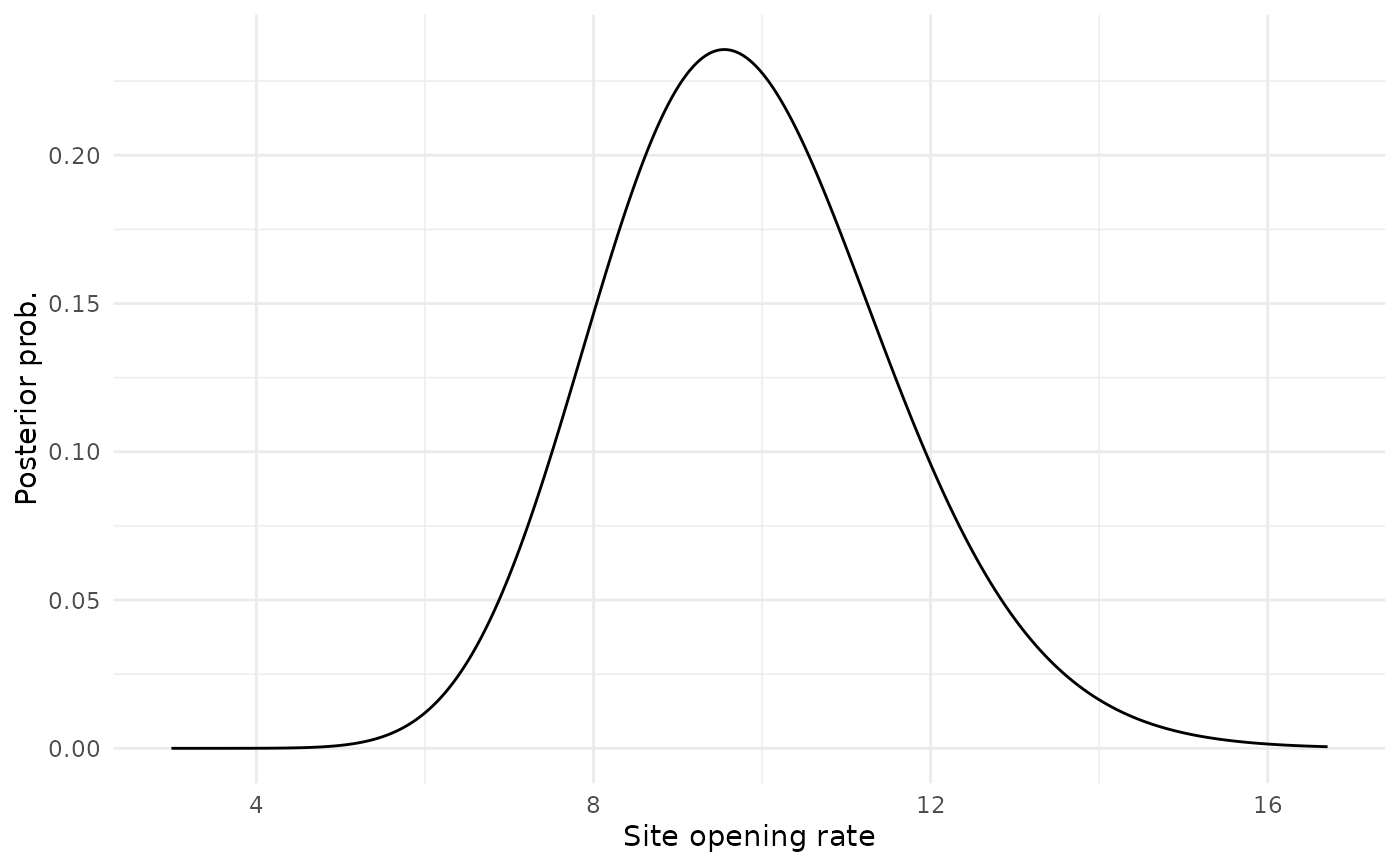
#> Posterior site opening rate hyperparamaters (Gamma):
#> shape rate
#> 33.00 3.35
#>
plot(analysis)
#> [[1]]
 #>
#> [[2]]
#>
#> [[2]]
 #>
#> [[3]]
#>
#> [[3]]
 #>
#> [[4]]
#>
#> [[4]]
 #>
# }
#>
# }